
Evidence-based decision-making toolkit
Commissioned by elrha and co-developed with humanitarian innovators from Bangladesh, India, Indonesia, Kenya, Syria and Uganda.
The Task
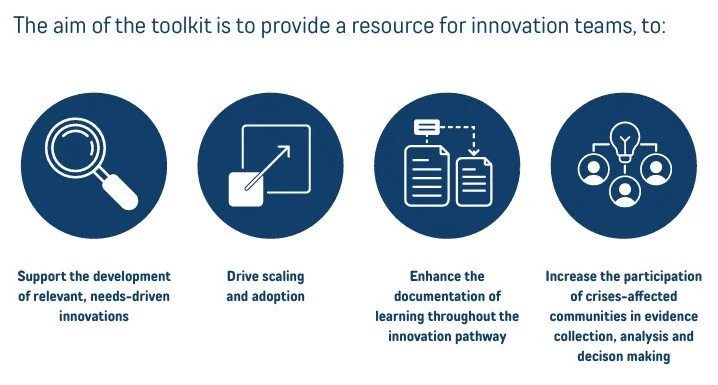
Elrha identified a need to strengthen how humanitarian innovation teams collect, interpret, and use evidence to inform design, adaptation, and scaling decisions. While grantees and applicants generate substantial data, many lack practical processes to apply formal evidence methodologies, document learning across the innovation pathway, meaningfully involve crisis-affected communities in evidence collection and analysis, and assess the potential impact, sustainability, and scalability of their work. The task was to develop a practical toolkit that would build these capabilities, support real-time learning and decision-making, and enable both innovators and Elrha’s Humanitarian Innovation Fund to make more consistent, evidence-based judgments without adding heavy reporting or evaluation burdens.
The process
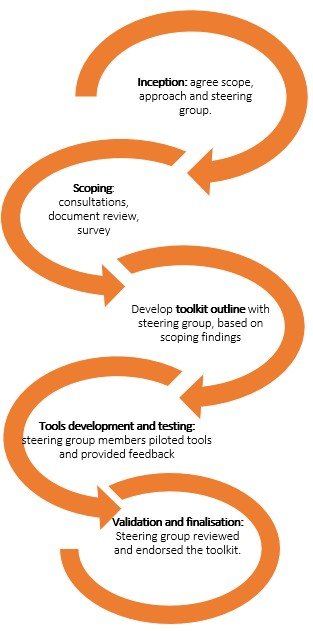
To ensure the toolkit was relevant and practical, we used a participatory and iterative testing approach with multiple innovation teams and country contexts:
Establishing expert steering group: We invited humanitarian innovators working with elrha to support and input into the development of the toolkit, guiding the approach, tool choices and testing the guide.
Scoping: We undertook consultations with elrha’s Humanitarian Innovation Fund (HIF) team, conducted a thorough desk-based review of existing toolkits, guides and manuals, drawing from across different sectors (51), and surveyed humanitarian innovation grantees. The Steering group reviewed the scoping findings and their reflections gathered to form the toolkit outline.
Toolkit outline: We developed a proposed outline of the five tools to be included and why based on the scoping and feedback. The Steering group provided feedback and the outline was adjusted accordingly.
Iterative prototyping: From this, we drafted the toolkit based on five core sections — evidence mapping, understanding your evidence, documenting learning and decisions, facilitating and signposting to other resources.
Testing: Three innovation teams piloted different tools and provided feedback on usability, clarity and relevance. This involved facilitated workshops and remote trials that highlighted where tools needed simplification or contextual tailoring.
Refinement and synthesis: Based on user feedback, we revised tool templates, instructions and example applications. We also developed short guidance notes illustrating how teams can integrate tools into regular project rhythms without adding reporting burden.
Validation and finalisation: The steering group reviewed the full toolkit draft, endorsed its practical focus, and helped shape the language to be accessible for non-technical audiences.
The Result
The Evidence-Based Decision-Making Toolkit supports humanitarian innovators to:
Map what evidence is actually needed, and by whom — making it clear which decisions require which types of evidence and which stakeholders should be involved.
Assess confidence in different evidence types — enabling teams to understand how reliable, representative, and relevant their data is for a given decision.
Co-interpret data collectively with colleagues, users, and affected communities — shifting from individual interpretation toward shared understanding.
Capture learning and decisions in real time — creating an accessible record of evidence use and decisions made, supporting adaptive management.
Integrate evidence into adaptive practice without creating heavy reporting demands.
“It’s very clear, not only for innovative projects, but also for other projects. It can be used as an innovative approach for M&E - especially collective sensemaking and emergent learning, can be used as new ways to demonstrate how our organisation can actually monitor and evaluate the current projects we have. If I'm writing a proposal in the future, I'll be adding these tools - it's very helpful.” Syria Bright Future
““Having all of these tools in one document is very important. We come across a lot of tools that we need for our work and we don't have a particular framework for using them, so having a framework that is collected together in one toolkit is very good.” International Foundation for Recovery and Development
Project Lead: Joanna Knight
In collaboration with: Liddy Greenaway and the Steering Group: Afsana Yeamin and Titly Sen (icddr,b), Amir Musataalhasan and Quasai Abuhilal (Syria Bright Future), Gideon Abako (International Foundation for Recovery and Development), Jessica Novia (Yakkum Indonesia), Meilinarti (Plan International Indonesia), Nadir Abusamra-Spencer (Light for the World), Remya Sasindran (Words. Rhythms. Images.), Dan Amias, Shirin Maani, Spencer Huchulak and Daniel Shaharudin (Elrha)
Themes: Co-production; Learning Together; Humanitarian Innovation